Technology Standards: Building Consistency That Scales
As our IT department has grown over the years, one thing has become increasingly clear: consistency doesn't happen by accident.
Every time we introduced a new piece of hardware, upgraded software, or deployed a new technology, our lead engineer and I would sit down together to develop a secure build and implementation guide. We would review vendor recommendations, evaluate security settings, determine which features aligned with our environment, and document exactly how we wanted that technology deployed.
The process worked well.
It produced consistent deployments and ensured every implementation followed the same approach regardless of who performed the work.
As our department grew, however, we discovered an unintended consequence.
While other engineers could successfully follow the implementation guides, they often didn't understand why those decisions had been made. Every new software release or hardware platform still required the same senior engineers to evaluate the risks, determine the configuration, and create the next build guide.
The implementation guides were doing their job.
The problem was that the knowledge behind them wasn't scaling with the team.
That's when I realized we weren't missing implementation guides.
We were missing technology standards.
Documentation Isn't the Goal
When people hear the phrase technology standards, they often picture shelves full of documentation that nobody reads.
That's not what I'm talking about.
The purpose of technology standards isn't to create paperwork. It's to create consistency.
Consistency means that every deployment follows the same expectations, every engineer starts from the same foundation, and every major technology decision is based on agreed-upon business objectives rather than personal preference.
When consistency exists, troubleshooting becomes easier, security improves, onboarding new employees becomes simpler, and the organization becomes less dependent on the knowledge of a few experienced individuals.
A Framework That Scales
One realization that came from these discussions is that not all documentation serves the same purpose.
I believe there are three distinct layers, each answering a different question.
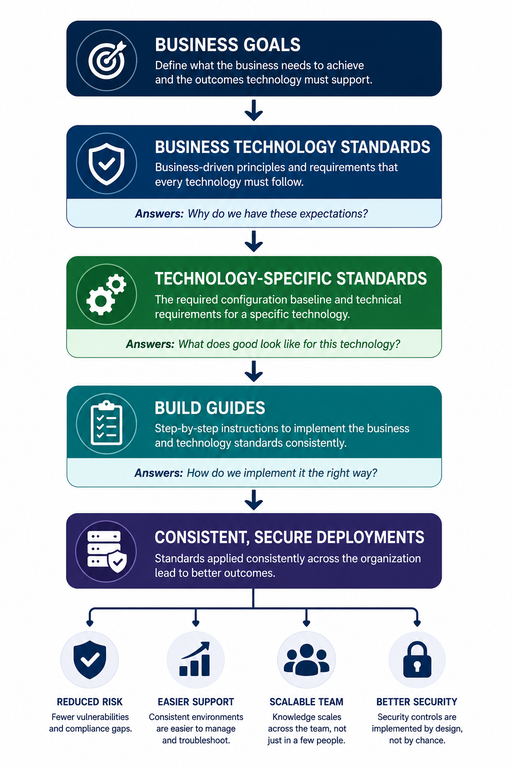
1. Business Technology Standards
Everything should begin with the business.
Business Technology Standards define the principles every technology must support. These are driven by business objectives, risk tolerance, regulatory requirements, and the way the organization operates.
Examples might include:
All new software and vendors must undergo a security review before implementation.
Multi-factor authentication should be required wherever technically possible.
Technology must comply with the organization's password policy.
Production changes must follow an approved change management process.
Critical systems require documented backup and recovery procedures.
Technologies that don't meet established security or compliance requirements will not be introduced into the environment.
For example, a utility company may require operational technology to remain air-gapped from the corporate network. That isn't a networking decision—it's a business decision based on operational risk. Once that expectation is established, it influences every technology decision that follows.
Business Technology Standards answer the question:
"What does our business expect from every technology we deploy?"
2. Technology-Specific Standards
Once the business principles are established, each technology can have its own standard.
A network standard may define secure management protocols, logging requirements, authentication methods, firmware expectations, and switch hardening.
A server standard may establish operating system baselines, monitoring requirements, administrative access, backup expectations, and patch management.
An endpoint standard may define antivirus requirements, BitLocker configuration, browser security, and local administrator policies.
These documents don't provide step-by-step instructions.
Instead, they define the technical requirements that each technology must meet to satisfy the organization's overall business standards.
Technology-Specific Standards answer the question:
"What does a properly configured version of this technology look like?"
3. Build Guides
Finally comes the build guide.
A build guide takes the business standards and technology-specific standards and translates them into a repeatable implementation process.
This is where naming conventions, IP addressing, installation order, screenshots, configuration examples, and validation steps belong.
Its purpose isn't to make design decisions.
Those decisions have already been made.
Its purpose is to ensure that every engineer can deploy the technology consistently while adhering to the organization's standards.
Build Guides answer the question:
"How do we implement these standards consistently every time?"
Why Separating These Documents Matters
Imagine Microsoft releases a new version of Windows Server.
Without standards, your team starts from scratch.
Should this security feature be enabled?
Which services should be disabled?
What authentication methods should be required?
Who decides what "secure" looks like?
Those questions often fall back to the same senior engineers because the reasoning behind previous decisions was never documented.
Now imagine your organization has Business Technology Standards and Technology-Specific Standards already in place.
Most of those decisions have already been made.
The engineer writing the new build guide isn't deciding what the organization believes. They're simply documenting how to implement those existing standards on the latest version of Windows Server.
That's a fundamentally different process.
Instead of relying on one or two individuals to reinvent every deployment, your organization creates a repeatable framework that allows knowledge to scale with the team.
Standards Should Continue to Evolve
One misconception is that standards are written once and forgotten.
I believe the opposite is true.
Every issue is an opportunity to improve the standard.
If a security vulnerability is discovered, update the standard.
If a deployment uncovers a better approach, update the standard.
If a vendor publishes new best practices, evaluate them and update the standard if appropriate.
Good standards are living documents that evolve alongside the business and the technology they support.
You Don't Need to Be a Large Enterprise
One misconception I often hear is that standards are only necessary for large organizations.
I don't believe that's true.
In fact, I think smaller organizations often benefit the most.
Creating standards doesn't mean documenting every setting or producing hundreds of pages of documentation.
Start by documenting the decisions that matter most.
Define the business principles your technology should support.
Then create technical standards for the technologies you rely on most.
From there, build implementation guides that allow those standards to be deployed consistently regardless of who performs the work.
You don't need to document everything on day one.
You simply need to begin capturing the decisions that shouldn't have to be made twice.
Final Thoughts
Looking back, I realized our challenge was never creating build guides.
Our challenge was creating an organization where knowledge could scale.
Business Technology Standards capture why the business makes certain technology decisions.
Technology-Specific Standards define what each technology must do to support those decisions.
Build Guides document how those standards are implemented consistently.
Together, they create a framework that reduces risk, improves consistency, simplifies onboarding, and enables your IT organization to grow without becoming dependent on a handful of experienced individuals.
Technology standards aren't about creating more documentation.
They're about ensuring that the knowledge your organization depends on becomes part of the organization itself.
